Hello,
I’d like advice on collision detection and the lift motion in a gasket picking project. Details below.
■ Environment
- Software: Mech-Vision / Mech-Viz [2.2.1 on site / testing on 2.2.2], Mech-Eye Viewer [version]
- Camera: Mech-Eye LSR L, firmware [version]
- Robot: HYUNDAI HH050 (Hi6 controller, Standard Interface)
- Camera setup: Eye-to-Hand (fixed mount)
- Camera height: about 2.21 m above the robot base
- Pick height: about Z = -0.38 m (robot base frame)
- Camera to objects: top m / bottom m (roughly 2.6 m to the pick level)
- Gripper TCP: X 163.8 / Y 64 / Z 460 mm
- Target objects: gaskets (long, hollow rectangular profile, about 75 × 55 mm cross-section) standing in slots on a cart
- The gaskets in the cart are thin, and they tilt slightly (about 1.2–3.4°)
■ Mech-Viz workflow
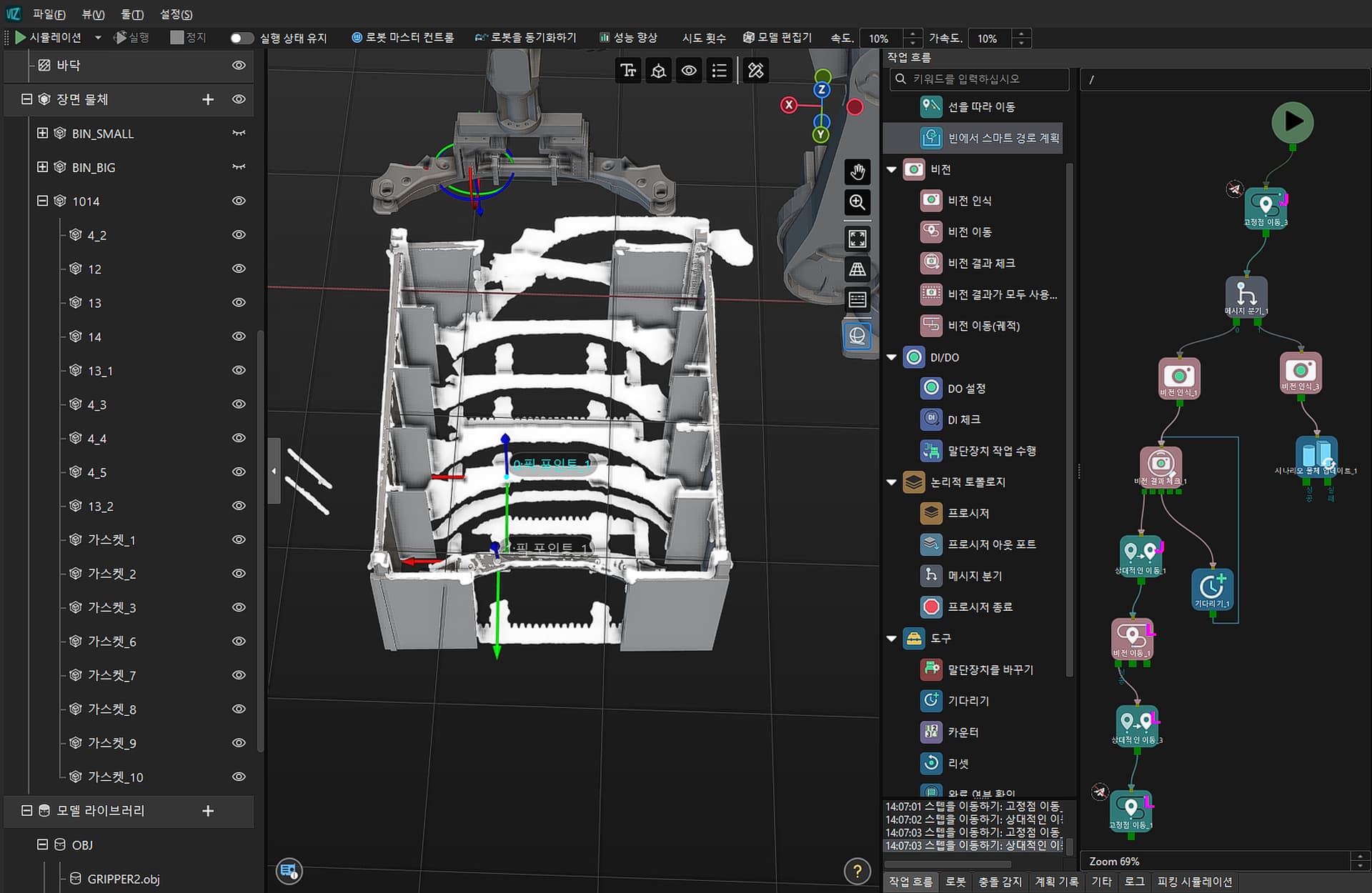
Fixed-Point Move → Message Branch → Vision Recognition → Check Vision Result → Relative Move (approach) → Vision Move (pick) → Relative Move (lift, +Z) → Fixed-Point Move
- The cart is modeled with scene objects: BIN_SMALL, BIN_BIG, and gasket_1–10
- Vision recognition uses a point-cloud-based matching model. No STL/CAD file of the target object is available.
■ Phenomena
- In the planning records, path planning failed many times because of collisions.
- One day’s log: 12 failures in total — 3 unreachable waypoints and 9 collisions between the end effector and unpicked target objects or scene objects.
- In one record, the gripper jaw model overlapped the wall of the gasket it was picking (collision volume about 3,600 mm³).
- In another record, the picked gasket collided with scene gaskets (gasket_3/6/7/9) and the BIN_SMALL wall during the lift.
- The gaskets are so thin that they barely appear in the point cloud. Because of this, point cloud collision detection doesn’t work reliably for them.
- On the real robot, the gasket scrapes against the neighboring gaskets while being lifted by Relative Move (+Z).
- After Vision Move, the pick pose includes rotation to match the tilted gasket.
- We think the vertical lift (robot base Z) doesn’t match the gasket’s tilted orientation.
■ Methods tried
- Analyzed collision volumes and positions in the planning records.
- Raised the end effector collision threshold to 2,000 mm³. This reduced some failures, but we’re concerned about missing real collisions.
- Removed label-based branching so that all objects are lifted vertically with one Relative Move. Scraping still occurs.
■ Questions
Q1. Without an STL of the target object, can we still use collision detection between the picked object and the scene?
For example, can we generate a collision model from the point cloud template or from primitive shapes (cuboid, etc.)? What is the recommended way?
Q2. For thin gaskets that don’t show in the point cloud, is it better to model them as scene objects?
- How accurately must the scene objects match the real cart, and how should we measure or calibrate their positions?
- If the cart position varies slightly each time, can the scene object poses be updated dynamically from vision results?
- Are there recommended collision threshold settings for thin objects?
Q3. How can we avoid scraping when lifting a gasket picked with rotation?
- Can Relative Move lift along the tool or object frame instead of the robot base Z?
- Is “Smart Path in Bin” suitable here, given that scene models can be set as bins in 2.2.2?
- Or would you recommend retracting a short distance along the tilt direction first, then lifting vertically?
■ Attachments
- Screenshot of the Mech-Viz scene objects and workflow
- Planning record screenshots showing the collision positions
- [Video of the scraping on site]
- [Mech-Vision project step screenshot]
Thank you.